
Hypothesis Testing with TOSTER
hypothesis_testing.RmdIntroduction
TOSTER was originally conceived as an equivalence testing package, but it is really a general-purpose hypothesis testing toolkit. Equivalence testing via the two one-sided tests (TOST) procedure is one of its core features, but the package also supports standard null hypothesis significance tests, non-inferiority testing, and superiority-by-a-margin testing through a single, consistent interface.
Many of TOSTER’s test functions return objects of class
htest, the same structure used by base R functions like
t.test(), wilcox.test(), and
cor.test(). This means results from TOSTER plug directly
into existing R workflows. On top of this, TOSTER provides helper
functions for tabulating, describing, and plotting test results that
work with most htest objects.
The central idea is simple: hypothesis testing involves specifying a
null hypothesis, choosing an alternative, and evaluating by a test. By
adjusting the alternative and mu (or
null depending on the function) arguments in TOSTER’s
functions, you can move seamlessly between testing frameworks. A
standard nil-hypothesis test, an equivalence test, a non-inferiority
analysis, and a superiority-by-a-margin test are all handled by the same
interface.
Throughout this vignette we use the built-in sleep
dataset, which contains extra hours of sleep (extra) for 10
subjects under two drug conditions (group).
The simple_htest Interface
simple_htest() is a unified wrapper for common two-group
(and one-sample) hypothesis tests. It calls base R’s
t.test() or wilcox.test() under the hood but
improves the output in two ways:
- Sample sizes are reported are saved in the output (base R does not record n).
- The effect is shown explicitly as a difference (e.g., “mean difference (1 - 2)”) rather than listing two group means and leaving the reader to compute the difference.
Basic usage: two-sample t-test
A standard two-sided t-test with simple_htest looks just
like t.test() but with a formula interface and explicit
mu argument:
test1 = simple_htest(extra ~ group,
             data = sleep,
             mu = 0,
             alternative = "two.sided")

test1$sample_size
#>  1  2
#> 10 10
Compare this with base R’s t.test():
t.test(extra ~ group, data = sleep)
#>
#>  Welch Two Sample t-test
#>
#> data:  extra by group
#> t = -1.8608, df = 17.776, p-value = 0.07939
#> alternative hypothesis: true difference in means between group 1 and group 2 is not equal to 0
#> 95 percent confidence interval:
#>  -3.3654832  0.2054832
#> sample estimates:
#> mean in group 1 mean in group 2
#>            0.75            2.33
Notice that simple_htest saves the sample sizes in each
group and appends the mean difference to the output, saving the reader a
calculation step. Additionally, notice how group labels are applied so
you don’t have to guess which group mean was sbutracted from which
(i.e., mean difference ('1' - '2')).
Wilcoxon test
To run a nonparametric Wilcoxon rank-sum test instead of a t-test,
set the test argument:
simple_htest(extra ~ group,
             data = sleep,
             test = "wilcox.test",
             mu = 0,
             alternative = "two.sided")
#>
#>  Wilcoxon rank sum exact test
#>
#> data:  extra by group
#> W = 25.5, p-value = 0.06582
#> alternative hypothesis: true location shift is not equal to 0
#> 96.3 percent confidence interval:
#>  -3.6  0.1
#> sample estimates:
#> Hodges-Lehmann estimate ('1' - '2')
#>                               -1.35
The output includes the Hodges-Lehmann estimate of the location shift. Please note that this estimate is not a the mean or median difference, but rather the median of all pairwise differences between groups (for the two-sample case) or Walsh averages (one-sample/paired). This is a robust measure of central tendency that is less sensitive to outliers than the mean difference.
Equivalence testing (TOST)
To test whether the difference between groups falls within a
set of equivalence bounds, set alternative = "equivalence"
and specify the bounds via mu. The TOST procedure tests the
null hypothesis that the true effect lies outside the bounds using two
one-sided tests.
simple_htest(extra ~ group,
             data = sleep,
             mu = 2,
             alternative = "equivalence")
#>
#>  Welch Two Sample t-test
#>
#> data:  extra by group
#> t = 0.49465, df = 17.776, p-value = 0.3135
#> alternative hypothesis: equivalence
#> null values:
#> difference in means difference in means
#>                  -2                   2
#> 90 percent confidence interval:
#>  -3.0533815 -0.1066185
#> sample estimates:
#>           mean of group '1'           mean of group '2'
#>                        0.75                        2.33
#> mean difference ('1' - '2')
#>                       -1.58
Here, mu = 2 defines symmetric equivalence bounds of
(-2, 2). The confidence interval is reported at the 1 - 2α level (90% by
default), which is the appropriate interval for TOST. If the 90% CI
falls entirely within the bounds, the test is significant and we can
conclude equivalence.
You can also specify asymmetric bounds by passing a two-element vector:
simple_htest(extra ~ group,
             data = sleep,
             mu = c(-1, 3),
             alternative = "equivalence")
#>
#>  Welch Two Sample t-test
#>
#> data:  extra by group
#> t = -0.68308, df = 17.776, p-value = 0.7483
#> alternative hypothesis: equivalence
#> null values:
#> difference in means difference in means
#>                  -1                   3
#> 90 percent confidence interval:
#>  -3.0533815 -0.1066185
#> sample estimates:
#>           mean of group '1'           mean of group '2'
#>                        0.75                        2.33
#> mean difference ('1' - '2')
#>                       -1.58
Beyond Equivalence: Non-Inferiority and Superiority by a Margin
TOSTER handles the full family of margin-based hypothesis tests, not just equivalence.
Non-inferiority testing asks: “Is the effect not
worse than some threshold?” This is operationalized as a one-sided test
against a shifted null. For instance, if we want to show that the mean
difference between drug groups is not less than -1 (i.e., group 1 is not
meaningfully worse than group 2 by more than 1 hour), we test with
mu = -1 and alternative = "greater":
simple_htest(extra ~ group,
             data = sleep,
             mu = -1,
             alternative = "greater")
#>
#>  Welch Two Sample t-test
#>
#> data:  extra by group
#> t = -0.68308, df = 17.776, p-value = 0.7483
#> alternative hypothesis: true difference in means is greater than -1
#> 95 percent confidence interval:
#>  -3.053381       Inf
#> sample estimates:
#>           mean of group '1'           mean of group '2'
#>                        0.75                        2.33
#> mean difference ('1' - '2')
#>                       -1.58
If the p-value is below α, we can conclude non-inferiority: the true difference is greater than -1.
Superiority by a margin asks: “Does the effect exceed a positive threshold?” For example, to test whether the difference exceeds +1 hour:
simple_htest(extra ~ group,
             data = sleep,
             mu = 1,
             alternative = "greater")
#>
#>  Welch Two Sample t-test
#>
#> data:  extra by group
#> t = -3.0385, df = 17.776, p-value = 0.9964
#> alternative hypothesis: true difference in means is greater than 1
#> 95 percent confidence interval:
#>  -3.053381       Inf
#> sample estimates:
#>           mean of group '1'           mean of group '2'
#>                        0.75                        2.33
#> mean difference ('1' - '2')
#>                       -1.58
These are one-sided tests against a non-zero null, not equivalence
tests. TOSTER handles them through the same simple_htest
interface by adjusting mu and alternative.
Other Test Functions
TOSTER provides several additional functions that return
htest objects. Each supports the same
alternative options (“two.sided”, “less”, “greater”,
“equivalence”, “minimal.effect”), making them interchangeable with the
helper functions described later. Here are just a few key functions in
the package:
Brunner-Munzel test
The Brunner-Munzel test is a robust nonparametric test for stochastic superiority. Unlike the Wilcoxon test, it does not assume equal variances or equal shape of distributions. The null hypothesis is that the relative effect (probability that a random observation from one group exceeds one from the other) equals 0.5:
brunner_munzel(extra ~ group, data = sleep)
#> Sample size in at least one group is small (< 30). The permutation test (test_method = 'perm') is recommended.
#>
#>  Two-sample Brunner-Munzel test
#>
#> data:  extra by group
#> t = -2.1447, df = 16.898, p-value = 0.04682
#> alternative hypothesis: true relative effect is not equal to 0.5
#> 95 percent confidence interval:
#>  0.01387048 0.49612952
#> sample estimates:
#> P('1'>'2') + .5*P('1'='2')
#>                      0.255
Bootstrap Correlation test
boot_cor_test() tests correlations using the bootstrap
methods similar to those mentioned by @wilcox2011introduction and supports equivalence
bounds on the correlation coefficient:
boot_cor_test(mtcars$mpg, mtcars$hp,
           method = "pearson",
           alternative = "two.sided",
           null = 0)
#>
#>  Bootstrapped Pearson's product-moment correlation (studentized)
#>
#> data:  mtcars$mpg and mtcars$hp
#> N = 32, p-value = 0.001001
#> alternative hypothesis: true correlation is not equal to 0
#> 95 percent confidence interval:
#>  -0.8932041 -0.4730167
#> sample estimates:
#>          r
#> -0.7761684
Bootstrap t-test
boot_t_test() provides a bootstrap alternative to the
standard t-test, which is useful when distributional assumptions are
questionable:
set.seed(2101)
boot_t_test(extra ~ group,
            data = sleep,
            mu = 0,
            alternative = "two.sided",
            R = 999)
#>
#>  Bootstrapped Welch Two Sample t-test (studentized)
#>
#> data:  extra by group
#> t-observed = -1.8608, df = 17.776, p-value = 0.07207
#> alternative hypothesis: true difference in means is not equal to 0
#> 95 percent confidence interval:
#>  -3.3481655  0.1582626
#> sample estimates:
#>           mean of group '1'           mean of group '2'
#>                        0.75                        2.33
#> mean difference ('1' - '2')
#>                       -1.58
Permutation t-test
perm_t_test() provides a permutation-based test that
makes minimal distributional assumptions:
set.seed(8251)
perm_t_test(extra ~ group,
            data = sleep,
            mu = 0,
            alternative = "two.sided",
            R = 999)
#> Note: Number of permutations (R = 999) is less than 1000. Consider increasing R for more stable p-value estimates.
#>
#>  Randomization Permutation Welch Two Sample t-test
#>
#> data:  extra by group
#> t-observed = -1.8608, df = 17.776, p-value = 0.096
#> alternative hypothesis: true difference in means is not equal to 0
#> 95 percent confidence interval:
#>  -3.4338982  0.2738982
#> sample estimates:
#>           mean of group '1'           mean of group '2'
#>                        0.75                        2.33
#> mean difference ('1' - '2')
#>                       -1.58
All of these functions return objects of class htest, so
the helper functions described next work identically with any of
them.
Converting t_TOST Results
Users of TOSTER’s original t_TOST() and
wilcox_TOST() functions can convert their results to
htest format using as_htest(). This allows the
full suite of helper functions to be used with older-style TOST
output.
tost_res <- t_TOST(extra ~ group,
                   data = sleep,
                   eqb = 2)
as_htest(tost_res)
#>
#>  Welch Two Sample t-test
#>
#> data:  extra by group
#> t = 0.49465, df = 17.776, p-value = 0.3135
#> alternative hypothesis: equivalence
#> null values:
#> mean difference mean difference
#>              -2               2
#> 90 percent confidence interval:
#>  -3.0533815 -0.1066185
#> sample estimates:
#> mean difference
#>           -1.58
The resulting htest object contains the test statistic,
p-value, confidence interval, and equivalence bounds from the original
TOST analysis. Note, the htest output will only show the
equivalence test, not the two one-sided tests separately or the
nil-hypothesis significance test, but the key information is preserved
for reporting.
Helper Functions for Reporting
TOSTER includes three helper functions that work with any
htest object: df_htest() for tabulation,
describe_htest() for text descriptions, and
plot_htest_est() for visualization.
df_htest(): Tabulating results
df_htest() converts an htest object into a
data frame, making it easy to build summary tables:
res_t <- simple_htest(extra ~ group, data = sleep, mu = 0)
df_htest(res_t)
#>                    method         t       df    p.value mean difference
#> 1 Welch Two Sample t-test -1.860813 17.77647 0.07939414           -1.58
#>         SE  lower.ci  upper.ci conf.level alternative null
#> 1 0.849091 -3.365483 0.2054832       0.95   two.sided    0
The test_statistics, show_ci, and
extract_names arguments control which columns appear in the
output.
describe_htest(): Text descriptions
describe_htest() generates a formatted text summary
suitable for reporting:
describe_htest(res_t)
#> [1] "The Welch Two Sample t-test is not statistically significant (t(17.776) = -1.86, p = 0.079, mean of group '1' = 0.75, mean of group '2' = 2.33, mean difference ('1' - '2') = -1.58, 95% C.I.[-3.37, 0.205]) at a 0.05 alpha-level. The null hypothesis cannot be rejected. At the desired error rate, it cannot be stated that the true difference in means is not equal to 0."
For an equivalence test, the description adapts to reflect the TOST procedure:
res_equiv <- simple_htest(extra ~ group, data = sleep,
                           mu = 2, alternative = "equivalence")
describe_htest(res_equiv)
#> [1] "The Welch Two Sample t-test is not statistically significant (t(17.776) = 0.495, p = 0.313, mean of group '1' = 0.75, mean of group '2' = 2.33, mean difference ('1' - '2') = -1.58, 90% C.I.[-3.05, -0.107]) at a 0.05 alpha-level. The null hypothesis cannot be rejected. At the desired error rate, it cannot be stated that the true difference in means is between -2 and 2."
This is useful for inline reporting in R Markdown. For example, you
could write `r describe_htest(res_t)` to embed the result
directly in a sentence.
plot_htest_est(): Estimate plots
plot_htest_est() produces a point-range plot showing the
point estimate and confidence interval alongside the null value(s):
plot_htest_est(res_t)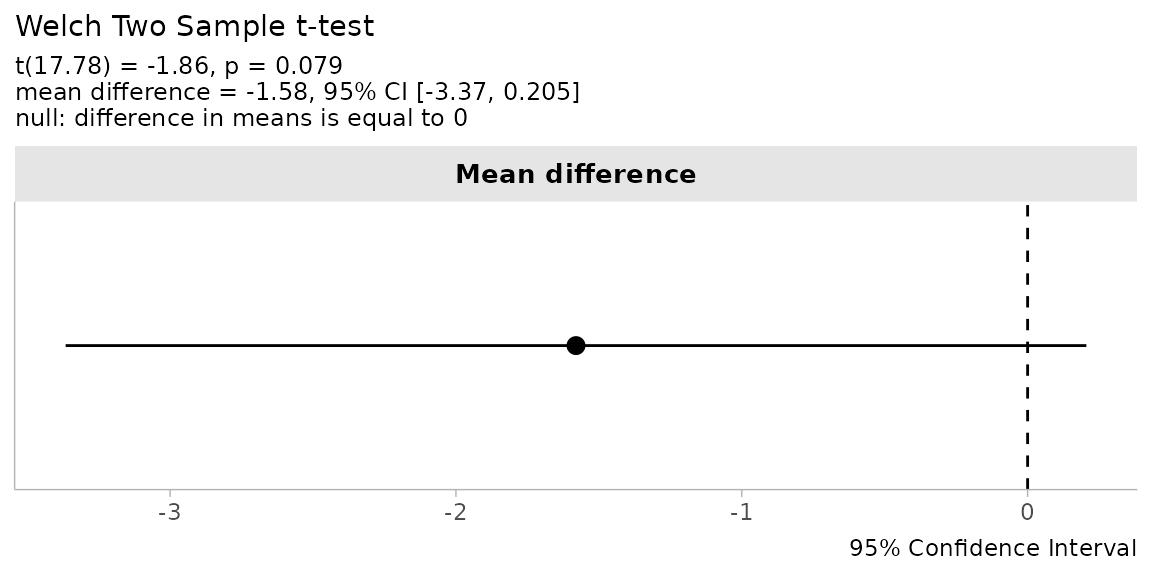
For equivalence tests, the plot displays both equivalence bounds as dashed reference lines:
plot_htest_est(res_equiv)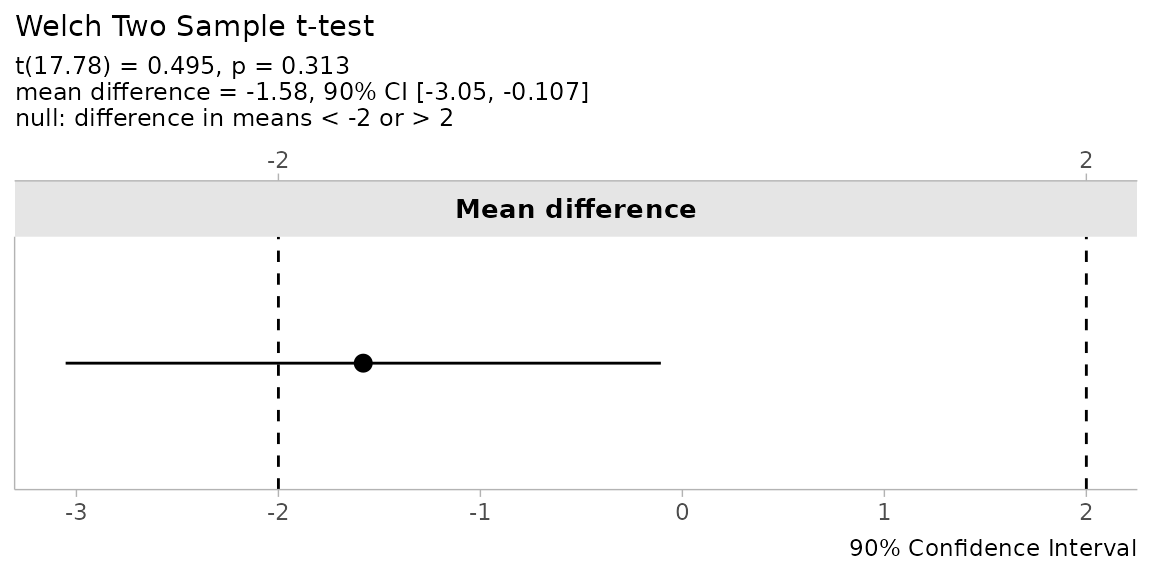
Set describe = FALSE for a cleaner plot without the
statistical summary in the subtitle:
plot_htest_est(res_equiv, describe = FALSE)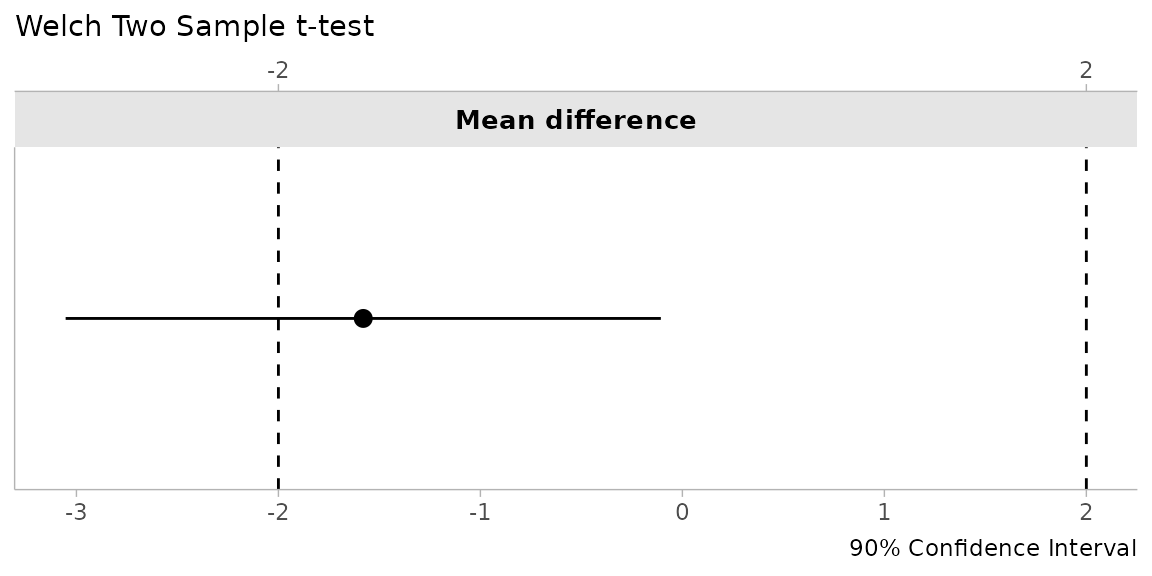
Because the result is a ggplot2 object, you can
customize it further with standard ggplot2 functions.
Putting It All Together
Here is a compact workflow tying together the full set of tools. We run an equivalence test, tabulate the result, describe it in text, and visualize it:
# Run equivalence test
result <- simple_htest(extra ~ group,
                       data = sleep,
                       mu = 2,
                       alternative = "equivalence")

# Tabulate
df_htest(result)
#>                    method         t       df   p.value mean difference       SE
#> 1 Welch Two Sample t-test 0.4946466 17.77647 0.3134536           -1.58 0.849091
#>    lower.ci   upper.ci conf.level alternative null1 null2
#> 1 -3.053381 -0.1066185        0.9 equivalence    -2     2

# Describe
describe_htest(result)
#> [1] "The Welch Two Sample t-test is not statistically significant (t(17.776) = 0.495, p = 0.313, mean of group '1' = 0.75, mean of group '2' = 2.33, mean difference ('1' - '2') = -1.58, 90% C.I.[-3.05, -0.107]) at a 0.05 alpha-level. The null hypothesis cannot be rejected. At the desired error rate, it cannot be stated that the true difference in means is between -2 and 2."

# Visualize
plot_htest_est(result)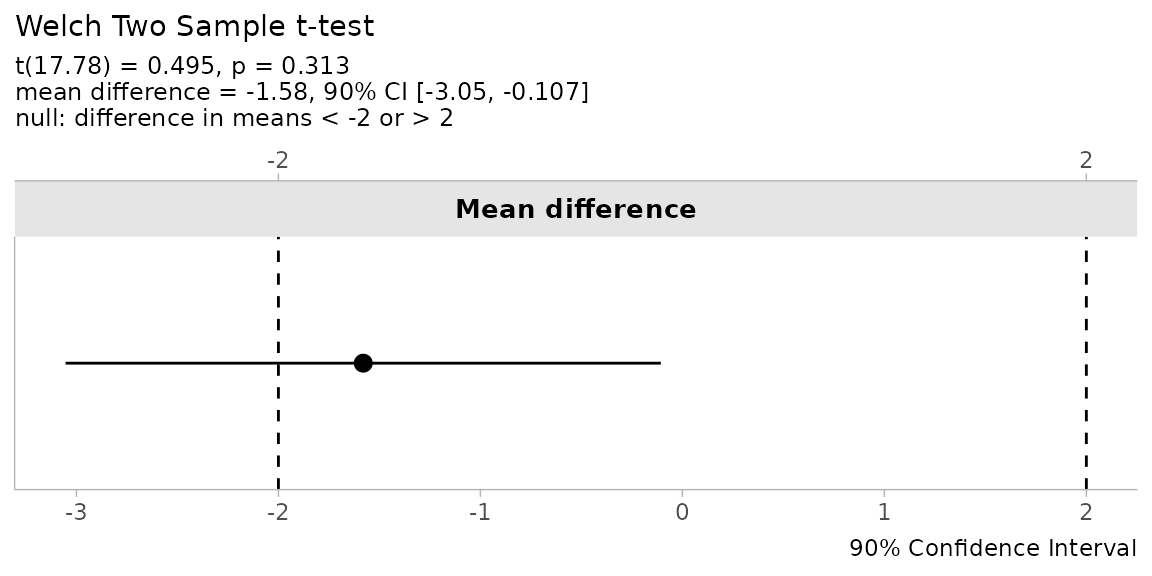
TOSTER provides a consistent, informative interface for hypothesis testing that goes well beyond equivalence. Whether you need a standard t-test with better output, a non-inferiority analysis, or a full TOST procedure, the same tools apply.