
![[Experimental]](figures/lifecycle-experimental.svg)
A robust, nonparametric method for fitting a straight line to two-dimensional data where both variables (X and Y) are measured with error. Particularly useful for method comparison studies.
Arguments
- formula
A formula of the form
y ~ xspecifying the model.- data
Data frame with all data.
- id
Column with subject identifier (optional). If provided, replicate measurements are averaged within each subject before fitting.
- method
Method for Passing-Bablok estimation. Options are:
"scissors": Scissors estimator (1988) - most robust, scale invariant (default)
"symmetric": Original Passing-Bablok (1983) - symmetric around 45-degree line
"invariant": Scale-invariant method (1984) - adaptive reference line
- conf.level
The confidence level required. Default is 95%.
- weights
An optional vector of case weights to be used in the fitting process. Should be NULL or a numeric vector.
- error.ratio
Must be 1 (the default). Values other than 1 are no longer supported and give an error; see "Measurement Error" in Details. Use
dem_reg()when the error variances of x and y differ.- replicates
Number of resamples for confidence intervals and the variance-covariance matrix. For
se_method = "bootstrap"this is the number of bootstrap resamples; forse_method = "jackknife"it is the number of random delete-d subsets. If 0 (default), analytical confidence intervals are used and no variance-covariance matrix is returned (unlessse_method = "dufey"). Resampling is recommended for weighted data and 'invariant' or 'scissors' methods.- se_method
Method used to estimate the variance-covariance matrix and confidence intervals of the coefficients. Options are:
"bootstrap": Nonparametric pairs (case) bootstrap with percentile confidence intervals (default). Used when
replicates > 0."jackknife": Delete-d jackknife with d = floor(n/2), using
replicatesrandom subsets (Shao & Wu, 1989). Used whenreplicates > 0."dufey":
Analytic sandwich
estimator of Dufey (2020). Does not require resampling (replicatesis ignored). Only available for the "scissors" method without case weights. Not used byjoint_test()orplot_joint()(see Details).
- model
Logical. If TRUE (default), the model frame is stored in the returned object. This is needed for methods like
plot(),fitted(),residuals(), andpredict()to work without supplyingdata. If FALSE, the model frame is not stored (saves memory for large datasets), but these methods will require adataargument.- keep_data
Logical indicator (TRUE/FALSE). If TRUE, intermediate calculations are returned; default is FALSE.
- ...
Additional arguments (currently unused).
Value
The function returns a simple_eiv object with the following components:
coefficients: Named vector of coefficients (intercept and slope).residuals: Residuals from the fitted model.fitted.values: Predicted Y values.model_table: Data frame presenting the full results from the Passing-Bablok regression.vcov: Variance-covariance matrix for slope and intercept (if resampling orse_method = "dufey"is used; otherwise NULL).df.residual: Residual degrees of freedom.call: The matched call.terms: The terms object used.model: The model frame.x_vals: Original x values used in fitting.y_vals: Original y values used in fitting.weights: Case weights (if provided).error.ratio: Always 1 (kept for compatibility).conf.level: Confidence level used.method: Character string describing the method.method_num: Numeric method identifier (1, 2, or 3).kendall_test: Results of Kendall's tau correlation test.cusum_test: Results of CUSUM linearity test.n_slopes: Number of slopes used in estimation.boot: Resampling results (if replicates > 0 andse_methodis "bootstrap" or "jackknife").se_method: Method actually used for standard errors ("analytic", "bootstrap", "jackknife", or "dufey").
Details
Passing-Bablok regression is a robust nonparametric method that estimates the slope as the shifted median of all possible slopes between pairs of points. The intercept is then calculated as the median of y - slope*x. This method is particularly useful when:
Both X and Y are measured with error
You want a robust method not sensitive to outliers
The relationship is assumed to be linear
X and Y are highly positively correlated
Methods
Three Passing-Bablok methods are available:
"scissors" (default): The scissors estimator (1988), most robust and scale-invariant. Uses the median of absolute values of angles.
"symmetric": The original method (1983), symmetric about the y = x line. Uses the line y = -x as the reference for partitioning points.
"invariant": Scale-invariant method (1984). First finds the median angle of slopes below the horizontal, then uses this as the reference line.
Measurement Error
Passing-Bablok regression implicitly assumes that the ratio of the error
variances of y and x equals the squared slope (equal error variances when
the slope is 1). Earlier versions accepted error.ratio != 1 (or estimated
it from replicates via id) and weighted the pairwise slopes by it. In
simulations this biased the slope (by -0.07 to -0.43 with an error ratio of
4), the bias did not shrink with sample size, and joint tests then rejected a
true identity line 81-100% of the time with n >= 50. error.ratio != 1 is
therefore an error. When the error variances differ, use dem_reg() with
the appropriate error.ratio (or id).
With id, replicate measurements are averaged within each subject and the
subject means are analysed.
Weighting
Case weights can be provided via the weights argument. Case weights allow
you to down-weight or up-weight specific observations in the analysis.
Standard Errors and Variance-Covariance Matrix
The analytical (Passing & Bablok, 1983) confidence intervals do not provide a
covariance between the intercept and slope, so a variance-covariance matrix
(needed by joint_test() and plot_joint()) is only returned when one of the
following is used:
Pairs bootstrap (
se_method = "bootstrap",replicates > 0): whole (x, y) observations are resampled with replacement and the model is refit. The variance-covariance matrix is the covariance of the bootstrap estimates and the confidence intervals are percentile intervals.Delete-d jackknife (
se_method = "jackknife",replicates > 0): the model is refit onreplicatesrandom subsets that each leave out d = floor(n/2) observations. The delete-1 jackknife is inconsistent for median-type estimators such as Passing-Bablok; deleting d observations with \(\sqrt{n}/d \to 0\) restores consistency (Shao & Wu, 1989). Confidence intervals are Wald-type intervals using a t(n-2) quantile.Dufey (2020) (
se_method = "dufey"): an analytic, distribution-free estimator for the equivariant ("scissors") Passing-Bablok estimator, based on the U-statistic variance of Kendall's tau and a sandwich estimator for the intercept. The slope interval is formed from order statistics of the pairwise slopes and the intercept interval is Wald-type. This option is experimental. In simulations its marginal intervals had close to nominal coverage for n >= 20, but a joint test of intercept and slope built from its variance-covariance matrix rejected a true null hypothesis 8-11% of the time at a nominal 5%.joint_test()andplot_joint()therefore refuse Dufey fits; use the pairs bootstrap or delete-d jackknife, which held 4.3-5.4% in the same simulations.
Resampling is particularly useful for:
Weighted regression (case weights)
Methods 'invariant' and 'scissors' (where analytical CI validity is uncertain)
Joint tests of intercept and slope
The method automatically:
Tests for high positive correlation using Kendall's tau
Tests for linearity using a CUSUM test
Computes confidence intervals (analytical or bootstrap)
References
Passing, H., & Bablok, W. (1983). A New Biometrical Procedure for Testing the Equality of Measurements from Two Different Analytical Methods. Application of linear regression procedures for method comparison studies in Clinical Chemistry, Part I. Cclm, 21(11), 709-720. doi: 10.1515/cclm.1983.21.11.709
Passing, H., & Bablok, W. (1984). Comparison of Several Regression Procedures for Method Comparison Studies and Determination of Sample Sizes Application of linear regression procedures for method comparison studies in Clinical Chemistry, Part II. Clinical Chemistry and Laboratory Medicine, 22(6). doi: 10.1515/cclm.1984.22.6.431
Bablok, W., Passing, H., Bender, R., & Schneider, B. (1988). A General Regression Procedure for Method Transformation. Application of Linear Regression Procedures for Method Comparison Studies in Clinical Chemistry, Part III. Clinical Chemistry and Laboratory Medicine, 26(11). doi: 10.1515/cclm.1988.26.11.783
Dufey, F. (2020). Derivation of Passing-Bablok regression from Kendall's tau. The International Journal of Biostatistics, 16(2), 20190157. doi: 10.1515/ijb-2019-0157
Sen, P. K. (1968). Estimates of the regression coefficient based on Kendall's tau. Journal of the American Statistical Association, 63(324), 1379-1389. doi: 10.1080/01621459.1968.10480934
Shao, J., & Wu, C. F. J. (1989). A general theory for jackknife variance estimation. The Annals of Statistics, 17(3), 1176-1197. doi: 10.1214/aos/1176347263
Examples
# Peak flow: mini vs Wright meter (Bland & Altman, 1986)
data("ba1986")
# Analytic confidence intervals (scissors method, default)
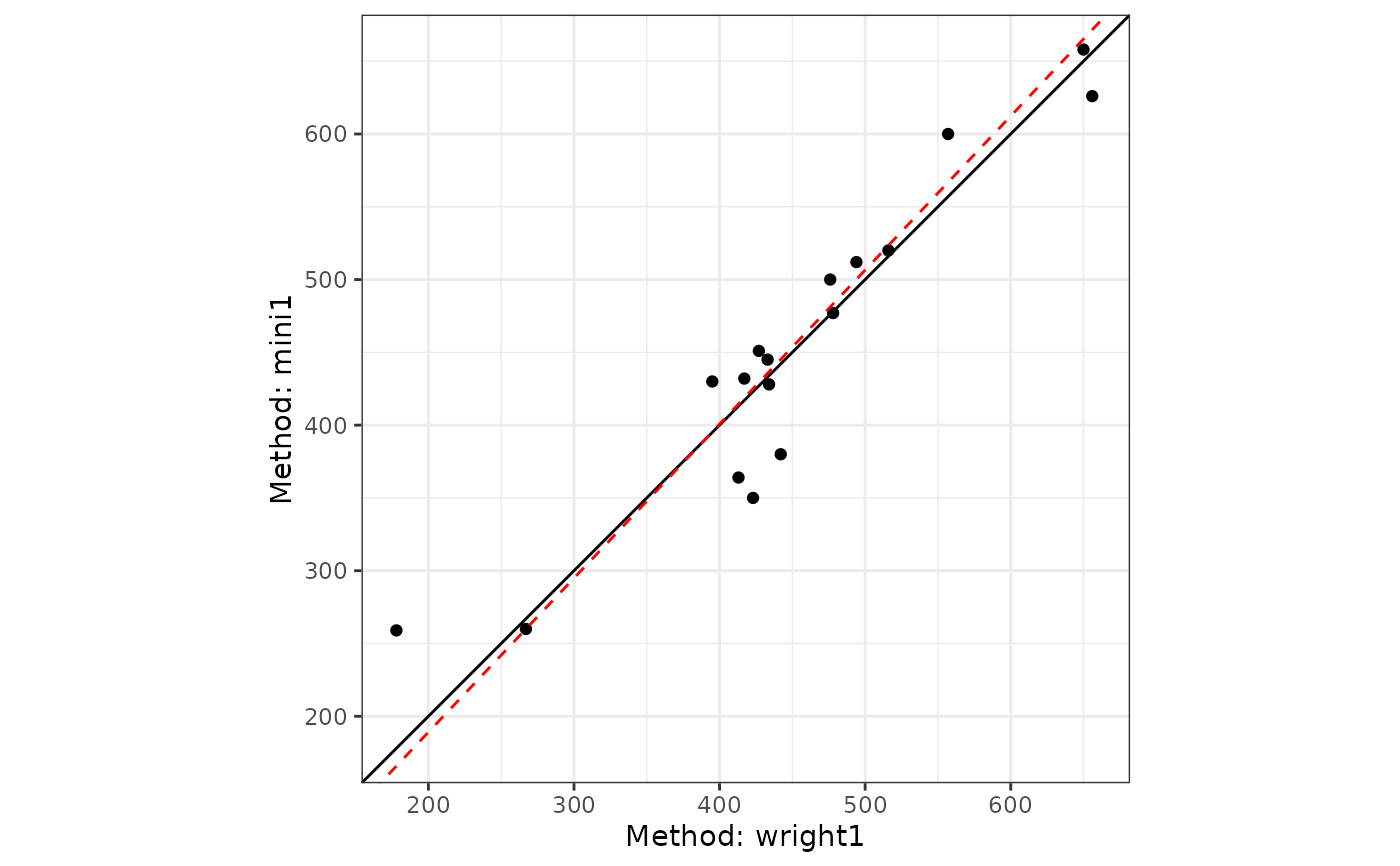
fit <- pb_reg(mini1 ~ wright1, data = ba1986)
#> Warning: Bootstrap confidence intervals are recommended for 'invariant' and 'scissors' methods. Consider setting replicates > 0.
summary(fit)
#> Passing-Bablok (scissors) with 95% C.I.
#>
#> Call:
#> pb_reg(formula = mini1 ~ wright1, data = ba1986)
#>
#> Coefficients:
#> term coef se lower.ci upper.ci df null_value reject_h0
#> 1 Intercept -22.502 59.8115 -153.2372 81.219 15 0 FALSE
#> 2 wright1 1.058 0.1289 0.8412 1.347 15 1 FALSE
#>
#> 15 degrees of freedom
#>
plot(fit)
 # Symmetric and scale-invariant methods
pb_reg(mini1 ~ wright1, data = ba1986, method = "symmetric")
#> Passing-Bablok (symmetric) with 95% C.I.
#>
#> Call:
#> pb_reg(formula = mini1 ~ wright1, data = ba1986, method = "symmetric")
#>
#> Coefficients:
#> (Intercept) wright1
#> -24.306 1.065
#>
#> Kendall's Tau (H0: tau <= 0):
#> tau: 0.7647
#> p-value: 0.0000
#>
#> CUSUM Linearity Test:
#> Test stat: 0.6667
#> p-value: 0.6601
#>
pb_reg(mini1 ~ wright1, data = ba1986, method = "invariant")
#> Warning: Bootstrap confidence intervals are recommended for 'invariant' and 'scissors' methods. Consider setting replicates > 0.
#> Passing-Bablok (scale-invariant) with 95% C.I.
#>
#> Call:
#> pb_reg(formula = mini1 ~ wright1, data = ba1986, method = "invariant")
#>
#> Coefficients:
#> (Intercept) wright1
#> -13.748 1.034
#>
#> Kendall's Tau (H0: tau <= 0):
#> tau: 0.7647
#> p-value: 0.0000
#>
#> CUSUM Linearity Test:
#> Test stat: 1.0000
#> p-value: 0.2827
#>
# \donttest{
# Bootstrap (or delete-d jackknife) variance-covariance matrix, needed for
# the joint test of intercept and slope; use more replicates in practice
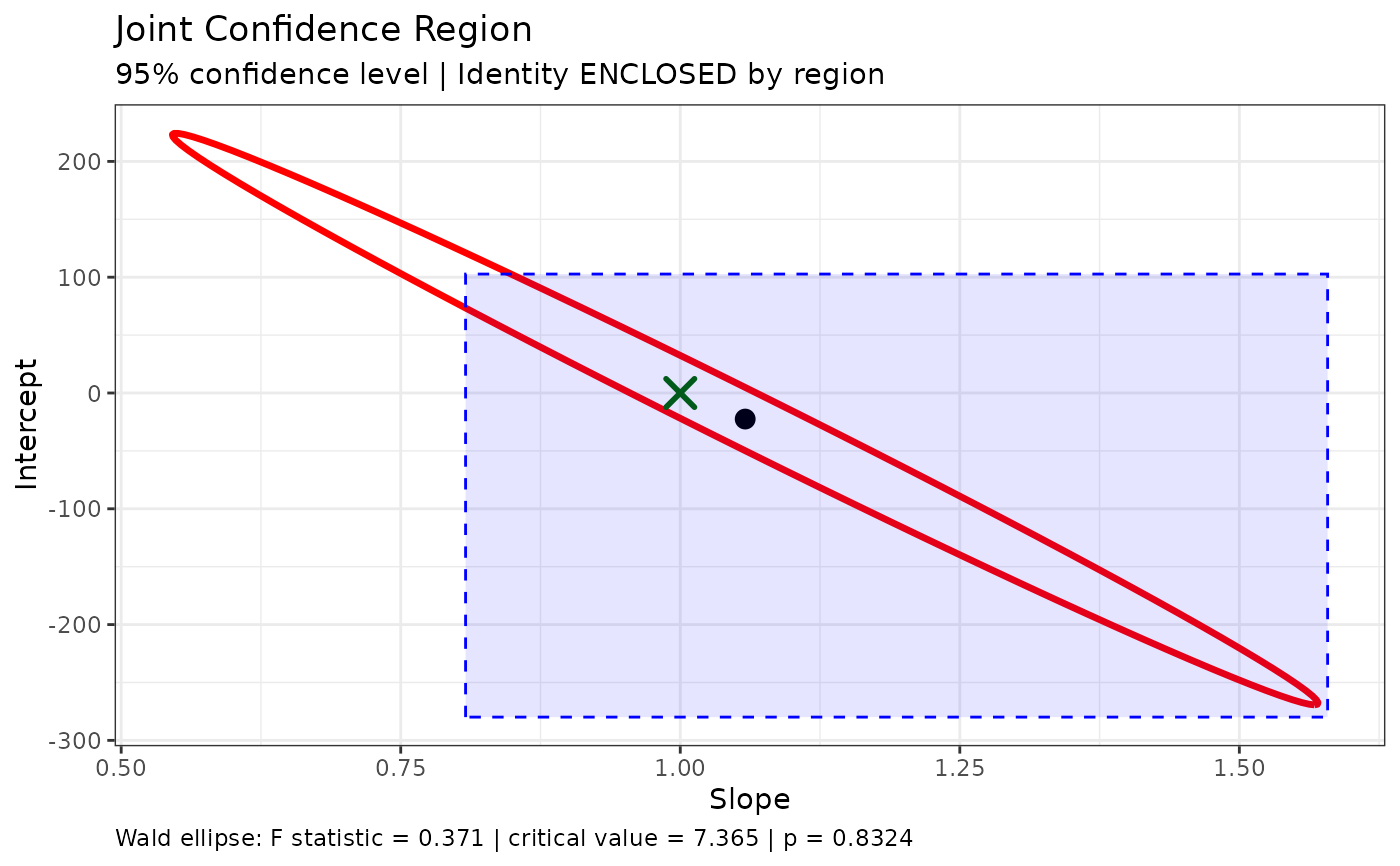
fit_boot <- pb_reg(mini1 ~ wright1, data = ba1986, replicates = 199)
joint_test(fit_boot)
#>
#> Joint Confidence Region Test [Wald, F-based] (H0: intercept = 0, slope
#> = 1)
#>
#> data: mini1 ~ wright1
#> X-squared = 0.37141, df1 = 2, df2 = 15, p-value = 0.8324
#> alternative hypothesis: true intercept and slope are not equal to the null values
#> null values:
#> intercept slope
#> 0 1
#> sample estimates:
#> intercept slope
#> -22.502332 1.058061
#>
plot_joint(fit_boot)
# Symmetric and scale-invariant methods
pb_reg(mini1 ~ wright1, data = ba1986, method = "symmetric")
#> Passing-Bablok (symmetric) with 95% C.I.
#>
#> Call:
#> pb_reg(formula = mini1 ~ wright1, data = ba1986, method = "symmetric")
#>
#> Coefficients:
#> (Intercept) wright1
#> -24.306 1.065
#>
#> Kendall's Tau (H0: tau <= 0):
#> tau: 0.7647
#> p-value: 0.0000
#>
#> CUSUM Linearity Test:
#> Test stat: 0.6667
#> p-value: 0.6601
#>
pb_reg(mini1 ~ wright1, data = ba1986, method = "invariant")
#> Warning: Bootstrap confidence intervals are recommended for 'invariant' and 'scissors' methods. Consider setting replicates > 0.
#> Passing-Bablok (scale-invariant) with 95% C.I.
#>
#> Call:
#> pb_reg(formula = mini1 ~ wright1, data = ba1986, method = "invariant")
#>
#> Coefficients:
#> (Intercept) wright1
#> -13.748 1.034
#>
#> Kendall's Tau (H0: tau <= 0):
#> tau: 0.7647
#> p-value: 0.0000
#>
#> CUSUM Linearity Test:
#> Test stat: 1.0000
#> p-value: 0.2827
#>
# \donttest{
# Bootstrap (or delete-d jackknife) variance-covariance matrix, needed for
# the joint test of intercept and slope; use more replicates in practice
fit_boot <- pb_reg(mini1 ~ wright1, data = ba1986, replicates = 199)
joint_test(fit_boot)
#>
#> Joint Confidence Region Test [Wald, F-based] (H0: intercept = 0, slope
#> = 1)
#>
#> data: mini1 ~ wright1
#> X-squared = 0.37141, df1 = 2, df2 = 15, p-value = 0.8324
#> alternative hypothesis: true intercept and slope are not equal to the null values
#> null values:
#> intercept slope
#> 0 1
#> sample estimates:
#> intercept slope
#> -22.502332 1.058061
#>
plot_joint(fit_boot)
 fit_jack <- pb_reg(mini1 ~ wright1, data = ba1986,
se_method = "jackknife", replicates = 199)
# Case weights
w <- rep(1, nrow(ba1986))
w[1:3] <- 2
pb_reg(mini1 ~ wright1, data = ba1986, weights = w, replicates = 199)
#> Passing-Bablok (scissors) with 95% C.I.
#>
#> Call:
#> pb_reg(formula = mini1 ~ wright1, data = ba1986, weights = w,
#> replicates = 199)
#>
#> Coefficients:
#> (Intercept) wright1
#> -7.562 1.037
#>
#> Kendall's Tau (H0: tau <= 0):
#> tau: 0.7647
#> p-value: 0.0000
#>
#> CUSUM Linearity Test:
#> Test stat: 0.8572
#> p-value: 0.3517
#>
# }
fit_jack <- pb_reg(mini1 ~ wright1, data = ba1986,
se_method = "jackknife", replicates = 199)
# Case weights
w <- rep(1, nrow(ba1986))
w[1:3] <- 2
pb_reg(mini1 ~ wright1, data = ba1986, weights = w, replicates = 199)
#> Passing-Bablok (scissors) with 95% C.I.
#>
#> Call:
#> pb_reg(formula = mini1 ~ wright1, data = ba1986, weights = w,
#> replicates = 199)
#>
#> Coefficients:
#> (Intercept) wright1
#> -7.562 1.037
#>
#> Kendall's Tau (H0: tau <= 0):
#> tau: 0.7647
#> p-value: 0.0000
#>
#> CUSUM Linearity Test:
#> Test stat: 0.8572
#> p-value: 0.3517
#>
# }