

Automatically determines the minimum sample size needed to achieve target statistical power for detecting specified bias in method comparison studies using Deming regression.
Usage
deming_sample_size(
  target_power = 0.9,
  initial_n = 20,
  max_n = 500,
  n_sims = 500,
  use_joint = NULL,
  step_size = 5,
  ...
)
Arguments
- target_power
Desired statistical power (e.g., 0.80 or 0.90). Default is 0.90.
- initial_n
Starting sample size for search. Default is 20.
- max_n
Maximum sample size to try. Default is 500.
- n_sims
Number of simulations per sample size tested. Default is 500.
- use_joint
Which target ends the search.
NULL(default) searches until both the joint-region and the confidence-interval targets are reached, so both sample sizes (and the reduction) are reported.TRUEstops at the joint-region target andFALSEat the confidence-interval target; the other sample size is then reported only if it was reached first.- step_size
Step size for sample size increments. Default is 5.
- ...
Additional arguments passed to deming_power_sim()
Value
A list of class "deming_sample_size" containing:
- n_required_ci
Required N for confidence intervals
- n_required_joint
Required N for joint confidence region
- target_power
Target power level
- power_curve
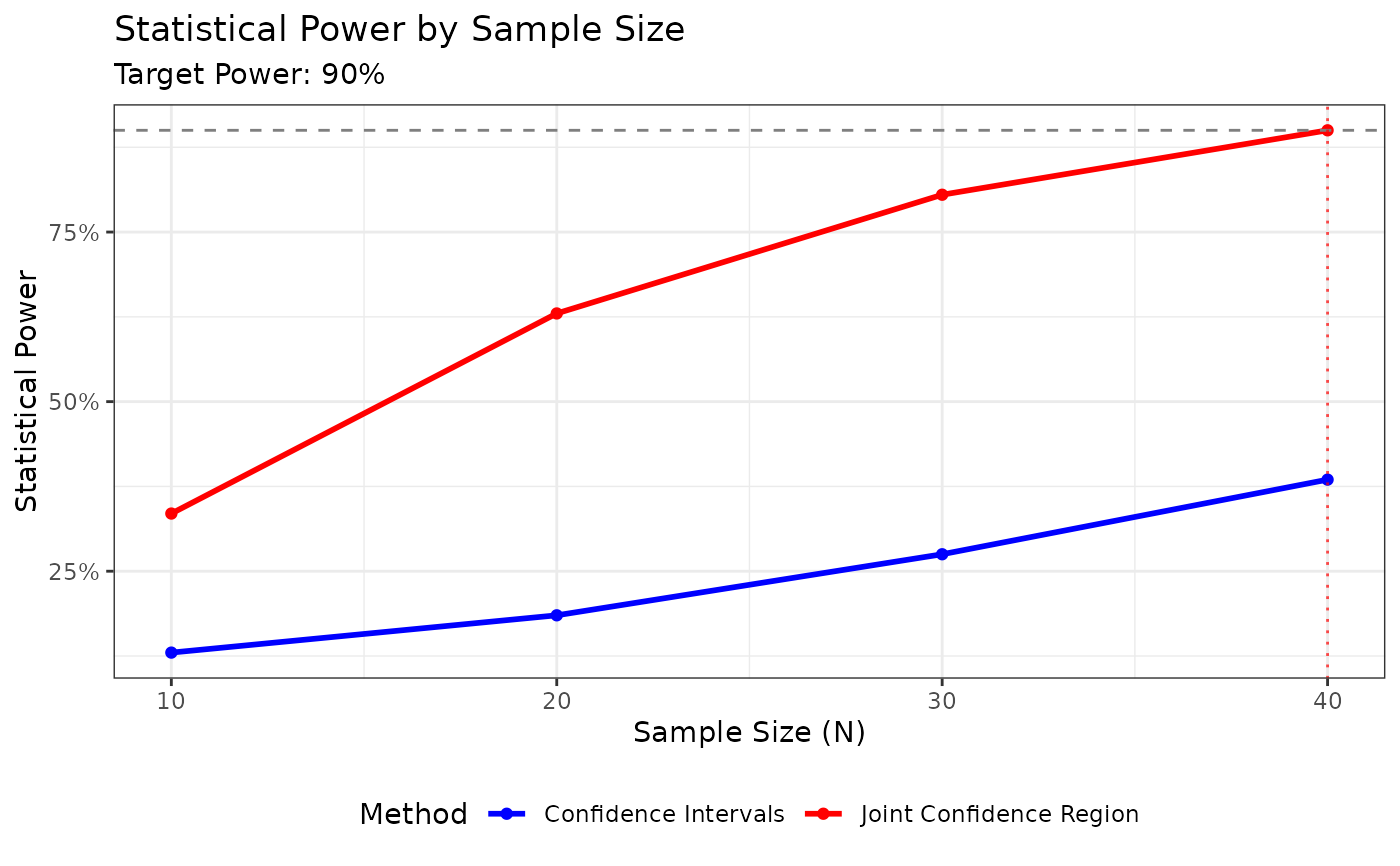
Data frame with N and power for both methods
- reduction_n
Sample size reduction using joint method
- reduction_pct
Percentage reduction
Details
This function performs a grid search over sample sizes to find the minimum N needed to achieve the target power. It tests both confidence interval and joint confidence region approaches, allowing comparison of required sample sizes.
Using joint confidence regions typically requires far fewer samples than confidence intervals when the measurement range is narrow (max:min ratio < 10:1).
Each power is a simulation estimate (Monte Carlo SE about 1.3 percentage
points at 90% power with n_sims = 500), and the search takes the first N
whose estimate reaches the target, which tends to pick N slightly too small.
In simulations the true power at the returned N was close to the target on
average but below 85% in up to 20% of runs. Use a larger n_sims (or check
the chosen N with deming_power_sim()) when the sample size matters. N is
never below initial_n.
Examples
# \donttest{
# Determine N needed for 90% power to detect 5% bias with the joint
# region (use_joint = TRUE stops there; n_sims = 500 or more in practice)
sample_size_result <- deming_sample_size(
target_power = 0.90,
initial_n = 10,
max_n = 200,
n_sims = 200,
step_size = 10,
use_joint = TRUE,
x_range = c(20, 200),
actual_slope = 1.05,
ideal_slope = 1.0,
y_var_params = list(beta1 = 1, beta2 = 0.05, J = 2, type = "power"),
x_var_params = list(beta1 = 0.8, beta2 = 0.04, J = 2, type = "power")
)
#> Searching for N to achieve 90% power...
#> Testing N = 10... CI: 13.0%, Joint: 33.5%
#> Testing N = 20... CI: 18.5%, Joint: 63.0%
#> Testing N = 30... CI: 27.5%, Joint: 80.5%
#> Testing N = 40... CI: 38.5%, Joint: 90.0%
#>
#> Target power achieved!
print(sample_size_result)
#>
#> === Deming Regression Sample Size Determination ===
#>
#> Target Power: 90%
#>
#> Required Sample Sizes:
#> Confidence Intervals: Not reached by N = 40 (search stopped at the joint target)
#> Joint Region: N = 40
plot(sample_size_result)
 # }